
why dashboards don’t equal knowledge
Published by 7Q Ltd – One Language to Plan, Communicate & Track Change
You’re tracking everything – every task, every milestone, every pound spent – yet you’re still none the wiser.
Your dashboard is full. Your RAG statuses are updated. Your reports land every week without fail.
But the one thing you actually need – clarity – never seems to show up.
That’s exactly what this week’s video breaks down, and it’s where 7Q becomes essential.
Because 7Q doesn’t just help you track more – it helps you track the right things, so you can finally turn data into decisions.
Because the reality is: you can track everything and still know nothing.
The Limits of Traditional Dashboards
Most dashboards only tell you three things:
- WHAT you’re doing
- WHEN you’ll deliver it
- HOW MUCH it costs
Useful? Yes.
Enough? Not even close.
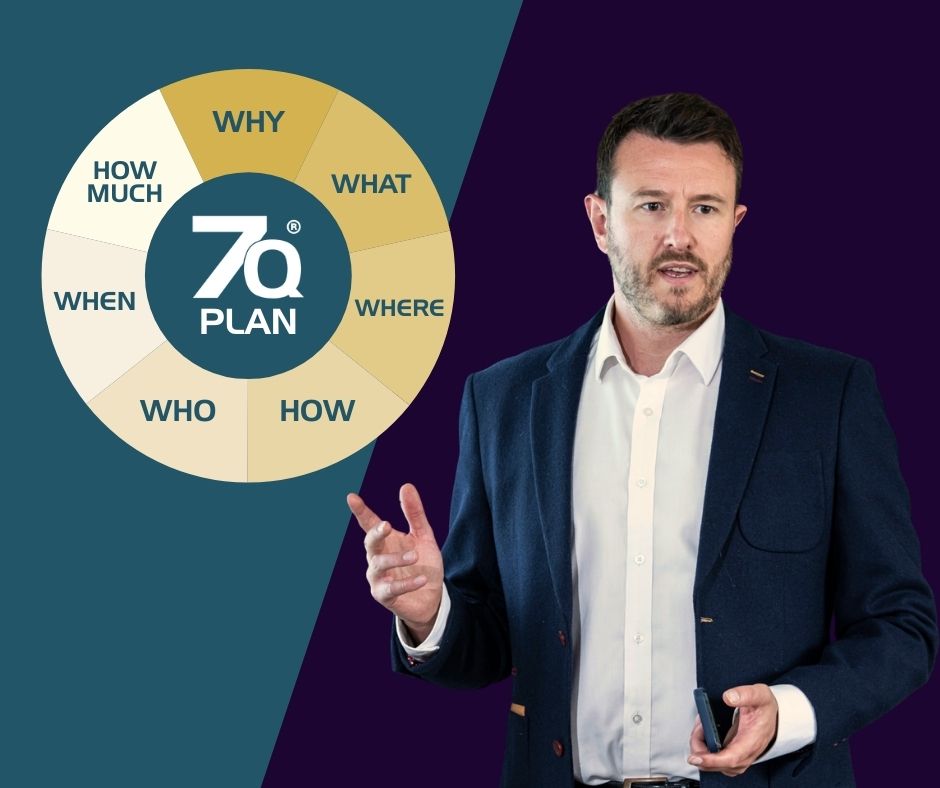
In 7Q terms, these are only three of the seven questions you actually need to run a plan properly.
The result? You only get a slice of the picture, not the whole thing. And slices don’t help you make decisions – they help you feel busy.
The Missing WHY
This is the biggest failure in most dashboards: you’re not tracking purpose.
You’re tracking tasks. You’re tracking spend. You’re tracking dates.
But you’re not tracking the one thing that actually matters: WHY you’re doing any of it.
In 7Q, the WHY is Question 1 – and it’s first for a reason.
If you don’t track purpose, you drift. You hit scope but miss benefits. You deliver outputs instead of outcomes.
As a result, you may find the project “delivered everything” – except the thing it was meant to achieve.
Why Purpose Must Be Tracked Weekly
Most leaders only review purpose at milestones, gateways, or quarterly reviews.
By the time you realise you’ve drifted, it’s too late.
Weekly tracking changes everything. It:
- Keeps your team aligned
- Stops drift before it starts
- Forces benefits back to the centre
- Makes purpose a living question, not a forgotten slide
And the most important question you should be asking every single week is:
“Will we hit purpose?”
If you can’t answer that, your dashboard isn’t a dashboard – it’s decoration.
The Problem With RAG Status
Most dashboards use RAG status – Red, Amber, Green – to show whether a project is on track.
In theory, it should be simple:
- Green = on track
- Amber = at risk
- Red = off track
But without rules, RAG stops being reporting and starts becoming performance art.
You’ve seen it:
- Someone picks amber because they “don’t want to worry anyone”
- Someone picks green because they “feel optimistic”
- Someone picks red because they’re frustrated, not because the numbers justify it
And when there are no thresholds for cost, time, or benefits, RAG becomes emotional, not factual.
A dashboard without rules isn’t reporting, it’s storytelling.
Governance Failure: The Sea of Red
Then there’s the other problem: everything is red, all the time.
At first glance, it looks like honesty. It looks like transparency.
But when every project is red, something far more serious is happening.
Because when everything is red:
- Nothing stands out
- Nothing gets escalated
- Nothing gets prioritised
- Nothing gets fixed
You can’t see which issues are urgent and which are noise.
You can’t tell the difference between a minor delay and a major failure.
You can’t make decisions because the dashboard gives you no hierarchy, no signal, no truth.
A dashboard full of red isn’t a warning system – it’s a sign that governance has stopped working.
It means no one is re‑forecasting. No one is resetting baselines. No one is taking ownership.
It means the system has given up on accuracy and settled for alarm.
Then, once ownership disappears, so does accountability – which brings us to the next problem.
Accountability and the WHO
When projects stay red indefinitely, accountability disappears.
No one knows who’s responsible for fixing what.
No one knows who’s escalating what.
No one knows who’s making decisions.
In 7Q, the WHO matters because delivery isn’t just about tasks – it’s about ownership.
Without clear roles for project leaders and leadership teams, you lose the feedback loop that keeps delivery honest.
The Fix: Re‑Baselining
If a project is genuinely off track, you don’t leave it red forever.
You re‑baseline.
Re‑baselining means you:
- Re‑forecast time
- Re‑forecast cost
- Re‑forecast resources
- Agree the new baseline
- Reset to green
This isn’t cheating.
This is restoring reality.
A project that stays red for months isn’t being managed – it’s being ignored.
The 7Q Approach to Tracking
Most dashboards fail because they only track fragments of the truth. They give you tasks, dates, and costs – but not the context, not the purpose, and not the accountability that actually drive delivery.
The 7Q approach fixes that by giving you the seven questions every successful project must be able to answer. It’s a simple framework, but it gives you a complete picture of what’s happening, why it’s happening, and whether it’s working.
The seven questions are:
- WHY – purpose
- WHAT – scope
- WHERE – location, environment, constraints
- HOW – approach
- WHO – accountability
- WHEN – time
- HOW MUCH – cost
When you track all seven, you stop reporting activity and start reporting reality.
You see the whole system, not just the symptoms.
You understand delivery, governance, and value in one view.
You can spot drift early, make decisions quickly, and intervene with confidence.
And you finally get the clarity you’ve been missing.
If you want to see how this works in practice, watch the video – and explore how 7Q turns dashboards into real insight.
Transcript:
Hello, I’m Fred and I’m gonna be talking to you today about why dashboards don’t equal knowledge.
And you may find in your business that it’s the changes, the projects, the transformations, the organisational changes, you’re tracking them, people are filling out information that goes into dashboards.
You’re tracking all the information, but you still feel none the wiser.
So we’re going to look at this and say, what are the reasons it doesn’t work?
This is a really, really simple view of scope, cost, and time, which in 7Q language is what, when, and how much.
And they are the second, sixth, and seventh questions.
The first reason the dashboard isn’t helping is because nobody is tracking the why.
The benefits, the purpose, the reason for doing the project in the first place is often missed in project dashboards.
And it doesn’t need checking every stage, or every few months.
It should be tracked weekly.
This is everyone’s main focus, to achieve the purpose of the project.
And because they focus on achieving the scope, not the purpose, you often don’t achieve the benefits.
So the why is missing.
Get why the purpose on your dashboard, specifically every week.
Will we hit purpose?
Will we hit?
The next thing that comes up are then rules.
Rules.
What does a red, amber or green mean?
You see in this rag status, red, amber, green.
What constitutes red, amber, green?
Is it really clear?
Or is it subject to someone’s feeling on a given day?
I’m gonna put red today because I feel this project’s really doing my head in.
I’ve got green today, I’m feeling positive, we’re gonna be okay.
You can’t operate like that.
For example, with cost, red might mean we’re more than 10% over budget.
Forecast or maybe it’s a number, we’re more than 10k over budget.
Time might be if it’s more than two or four weeks late, we go to red.
If it’s less than that, we stay green.
There needs to be rules.
Now there’s also a set of rules required then for governance and change.
For example, a project goes red.
It’s more than four weeks late.
What happens then?
In many organisations, the project just stays red.
It becomes a sea of red.
All the project dashboards just red, and the only projects that aren’t red are the brand new ones because they start green and then go red.
What information is coming through at this point?
You don’t know because the project that was two or three or four weeks late to begin with suddenly becomes two months, three months, six months.
And no one’s got a grip of it.
So what’s required is you take a project in red and you say re-baseline.
Which basically says you look at its status, you re-forecast all the aspects of it, how long is it gonna take us to finish this off, how much is it gonna realistically cost us, who do we need to do it, and let’s agree that.
And we put it back to green.
When it’s back to green, you’re now tracking a green project.
You’ve accepted reality, and now the project has to operate within the same old rules again.
If you’re more than two weeks late, you have to go back to red.
Now this means that you’re starting to understand what stays green after a couple of resets and what keeps going back to red.
It allows you to see which project leaders are being honest with how their project is progressing versus project leaders that are trying to just get through and massage the results as much as they can.
It’s very easy for a project leader, once a project’s red, to take little accountability for the outcomes.
Whereas if you’ve set them back to green and said, tell me what you need to do and I’ll give you my consent and you go back to being green, the accountability is now back on the project leader.
When it’s red, it’s really on the leadership team and not doing anything about it means that the team won’t do anything about it either.
So accountability is key.
And accountability falls under the who.
People having clear roles around what the project leader’s role is and what the leadership team’s role is in feeding back.
For example, when the report goes in from the project leader to the leadership, it’s very often not the case that there’s a feedback loop.
You need a feedback loop from the leadership team to the project leader to say, okay, I recognise that you sent in a report, that you’re having problems, that you’ve got issues, that you can’t get the resources.
And we as a leadership team are gonna take decisions.
Are we gonna prioritise?
Are we gonna put this project back?
Are we gonna do something different?
But just ignoring and having no feedback loop doesn’t help your business.
So in order to make the dashboards useful, it’s really around making sure you’re tracking while you’re doing your project.
In 7Q, we track all seven questions because they’re all pertinent.
Having rules around what constitutes Red Amber Green is key.
Having governance and change control about resetting projects back to green and then tracking them again and keep bringing them back into change control.
And then making sure everyone is accountable.
They’re the key reasons that your dashboards are not working.
See you next time.
Struggling with plans that look good on paper but fall apart in delivery?
Request a 7Q Change Governance Audit – a focused assessment that reveals why your strategies break down and where your planning, communication, or decision‑making is misaligned.